
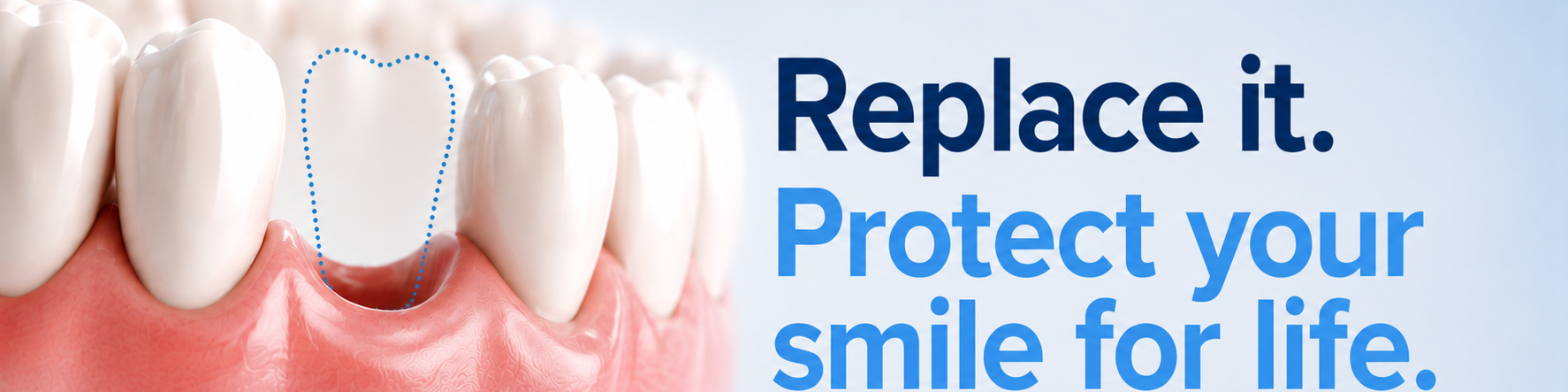
Why it's important to replace even a single missing tooth
May 27, 2026
Why Replacing Even One Missing Tooth Matters
Losing a tooth may seem like a minor issue — especially if it’s not visible when you smile. But even a single missing tooth can have a significant impact on your oral health, appearance, and overall quality of life.
At our practice, we often see patients who delay replacing a missing tooth because it “doesn’t bother them yet.” Unfortunately, waiting too long can lead to complications that become more difficult and costly to treat over time.
What Happens When a Tooth Is Missing?
Your teeth work together as a complete system. When one tooth is lost, the balance of that system changes.
1. Surrounding Teeth Begin to Shift
Each tooth helps support the teeth beside and opposite it. When a gap is left untreated, neighboring teeth can gradually drift or tilt into the empty space. Teeth in the opposing jaw may also begin to move.
This shifting can lead to:
- Bite problems
- Difficulty chewing
- Increased wear on other teeth
- Jaw discomfort or TMJ symptoms
- Crowding and alignment issues
Over time, these changes can make future tooth replacement more complex.
2. Bone Loss Begins Immediately
One of the most important reasons to replace a missing tooth is to preserve the jawbone.
Your natural tooth roots stimulate the jawbone every time you chew. When a tooth is lost, that stimulation disappears. As a result, the bone in that area begins to shrink and deteriorate.
Bone loss can:
- Change your facial appearance
- Create a sunken or aged look
- Affect gum tissue support
- Make future implant treatment more difficult
The longer the tooth is missing, the more bone loss can occur.
3. Chewing and Speaking Can Be Affected
Even one missing tooth can impact how you chew and speak.
Patients may begin avoiding certain foods because chewing becomes uncomfortable or inefficient. Over time, this can affect nutrition and digestion.
Depending on the location of the missing tooth, speech may also be affected, especially when pronouncing certain sounds.
4. Your Oral Health Can Decline
Gaps between teeth can become areas where food and bacteria collect more easily. When teeth shift, they can also become harder to clean properly.
This may increase the risk of:
- Tooth decay
- Gum disease
- Additional tooth loss
- Chronic inflammation
Replacing a missing tooth helps maintain the overall stability and health of your smile.
Why Dental Implants Are Often the Preferred Solution
Dental implants are considered one of the most effective and natural-feeling ways to replace a missing tooth.
Unlike traditional bridges, implants replace the tooth root as well as the visible tooth. This helps preserve the jawbone while restoring function and appearance.
Benefits of dental implants include:
- Preventing bone loss
- Helping stabilize neighbouring teeth
- Restoring chewing function
- Supporting long-term oral health
- Providing a natural look and feel
- Avoiding the need to alter adjacent healthy teeth
With proper care, dental implants can provide a long-lasting solution for missing teeth.
The Sooner You Replace a Missing Tooth, the Better
When it comes to tooth replacement, timing matters.
Replacing a tooth sooner can help prevent shifting, bone loss, and additional complications. Early treatment is often simpler and can help preserve more of your natural oral structures.
If you have recently lost a tooth — or have been living with a missing tooth for years — it’s never too late to explore your options.
Book a Consultation
If you are missing a tooth and would like to learn more about your replacement options, our team is here to help. We can assess your oral health, discuss treatment solutions, and create a plan that restores both function and confidence to your smile.
Contact the team at Quail Ridge Dental today to schedule a consultation.
This blog is based on educational information from Nobel Biocare regarding the effects of missing teeth and dental implant solutions.